Case study
Burrous Brothers Company
A fifty-year-old Mill Valley cleaning business, bought by a searcher on an SBA loan, more than doubling lead volume in the months after close.

- Category
- Local
- Industry
- Carpet, rug and tile cleaning
- Engagement
- Post-close local SEO and website rebuild
Results
+110%
Lead volume
Client reported Over the engagement
Context
Burrous Brothers Company is a carpet, rug and tile cleaning business in Mill Valley, founded in Marin in 1976 and still run locally.
It changed hands in early 2026, bought by a searcher on an SBA loan. That is the shape a lot of small business ownership takes now: a trade business with fifty years of customers and real revenue, acquired by someone who has not run it before, inheriting whatever web presence the last owner left behind. Here that was the whole of the marketing.
The work is local by definition. Nobody drives an hour to have a rug cleaned, so the entire addressable market is the set of households within a sensible radius of the van. That makes local search almost the whole channel, and it makes the competition a particular shape. A cleaning business does not lose to the one two towns over so much as to national booking platforms and directories, which rank in every market at once without having a presence in any of them.
What the new owner inherited was a website that had not been touched in over a decade, and a Google Business Profile set up years earlier and left alone, ranking outside the top twenty for the services the business actually sells. None of that had cost the previous owner anything, because fifty years in one town buys a lot of word of mouth. It costs a new owner a great deal, because a buyer carrying acquisition debt needs the phone to ring on a schedule.
What I found
The profile was configured as a service area business, with the address hidden and a list of towns served instead. That is the default most local businesses land on, and it is usually the wrong one when there is a real office, because it discards the single strongest input local ranking has.
Alongside that:
- Categories that described the business loosely rather than precisely
- Citations carrying several versions of the name, address and phone number
- No review process, so reviews arrived when a customer happened to think of it
- A decade-old site, with a blog that had not been touched in years
What I did
1. Moved the profile from a service area business to a physical location
This was the largest single change. A service area business has no coordinates for Google to measure proximity from, so it competes on prominence alone. A verified physical location gives the profile a point on the map, and the whole ranking surface around that point changes.
The business had a real office, which made this available. It is not a trick, and it is not available to a business that genuinely operates from a van and a home address.
2. Rebuilt the site and the content
A decade-old site was replaced rather than patched, and the content aimed at the questions people actually ask before booking this kind of work rather than at the service terms alone.
3. Category optimisation
Primary and secondary categories are among the strongest levers on the profile and among the most commonly left at whatever was picked on the first day. Getting the primary category exactly right, and the secondaries covering the real service mix rather than aspirations, is unglamorous and moves things.
4. Standardised the citations
One canonical version of the name, address and phone number, applied consistently across the sources Google actually reads. Inconsistent citations are not fatal on their own, but they are a drag on a profile that is otherwise trying to establish that it is a specific business at a specific address.
5. Built a review acquisition flow
Designed with the business rather than for it, because the part that determines whether a review process works is whether the people doing the jobs will actually run it. Asking at the right moment, consistently, by a route that takes the customer seconds.
No incentives and no filtering. Both violate Google’s policies, and a profile that gets caught doing either loses more than it gained.
6. Regular posting
Profile posts, on a schedule the business can sustain. The effect is modest compared with the structural work above, but it is cheap and it signals an active business.
Result
Lead volume went up 110 percent.
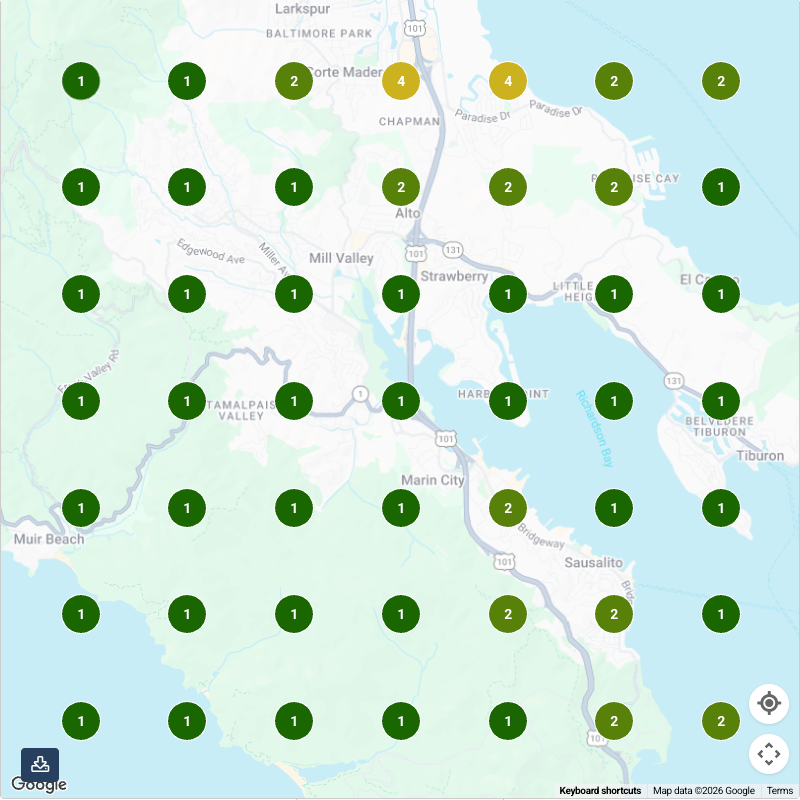
That is the number that matters, and it is downstream of a ranking change: the profile went from outside the top twenty to first or second across almost the whole service area, which is the difference between being found by someone looking for this service and not being found at all.
The scan below shows where the business ranks in the map pack for tile cleaning, measured from points across southern Marin. Almost every one of them now reads first.
Is your business in a similar position?
The first conversation is free and is a working session, not a sales call. Tell me what is going on and I will tell you what I would look at first.